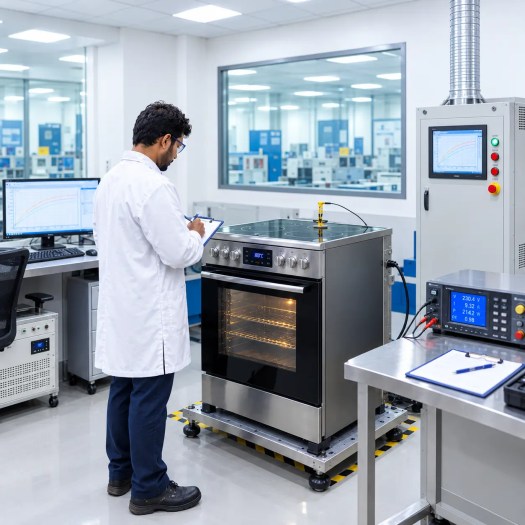
Door Drive Testing & Certification: IEC 60335-2-103 Compliance Guide

What is a Door Drive?

A door drive is a heavy-duty electro-mechanical and motorized appliance designed to automatically open, close, and position heavy doors, gates, garage doors, and industrial shutters rapidly and reliably in demanding commercial, residential, and industrial environments.


Why Must Door Drives Be Safety Tested or Evaluated Before Entering the Market?

Door Drive Testing

Door drives must undergo rigorous safety testing and evaluation before entering the market to protect users and property from severe crushing hazards, shearing injuries, entrapment, electric shocks, motor burnouts, and structural fires, because they combine high electrical power, high-torque mechanical actuators, heavy continuous physical loads, and operation in exposed indoor and outdoor weather environments.

• Electrical Shock and Short-Circuit Prevention: Door drives often operate in wet, dusty, or outdoor environments where moisture, rain, and environmental debris are constantly present. Inadequate internal insulation, faulty grounding, or poor cord anchorage can lead to severe electrical shocks or short circuits. Safety testing verifies insulation resistance and dielectric strength.

  • • Mechanical and Entrapment Hazard Mitigation: Operating with high closing forces and heavy moving panels means a failure in obstacle detection, limit switches, or emergency release mechanisms can result in severe operator injury or property damage. Mechanical endurance and entrapment protection tests simulate high-stress conditions to prevent accidental crushing or trapping.
  • • Thermal Endurance and Overload Control: Continuous or frequent cycle operations generate substantial internal heat within the high-torque motor and drive gears. Defective thermal cut-offs or inadequate ventilation can lead to motor burnout or internal electrical fires. Thermal endurance and abnormal operation tests simulate heavy-load jams and frequent usage to prevent hazardous failures.

• Electromagnetic Compatibility (EMC): Heavy-duty motorized door systems must not emit excessive electromagnetic interference that disrupts other local electronic security, access control, or communication systems, nor should they malfunction when exposed to standard environmental electrical noise and power surges found in commercial and industrial settings.

• Regulatory Compliance and Market Access: Global regulatory authorities (such as GSO in the GCC, CE in Europe, or equivalent international bodies) legally mandate third-party testing reports from an ISO/IEC 17025-accredited laboratory.

The Benchmark Standard: IEC 60335-2-103 for Door Drive Safety

IEC 60335-2-103 is the international safety standard that deals with the safety of electric drives for gates, doors, and windows for household and similar purposes, with a rated voltage being not more than 250V for single-phase appliances and 480V for multi-phase appliances. For commercial and industrial door drives, gates, and window operators, this standard defines the baseline requirements for electrical insulation, mechanical strength, thermal endurance, stability, obstacle detection, and fire resistance.

Door Drive Testing

Core Testing Parameters Under IEC 60335-2-103

Evaluating a door drive through a certified Door Drive Testing Lab involves subjecting the device to a series of rigorous mechanical and electrical stress tests outlined within the standard:

1. Classification & Marking Tests

• Protection Against Electric Shock: Verifies that the door drive is properly classified as Class I, Class II, or Class III.

• Water Ingress Protection (IPX Rating): Door drives (especially outdoor gate and shutter operators) must achieve high IP ratings (such as IP44, IP54, or higher) to withstand rain, dust, and jet water washdown requirements.

• Durability of Markings: Rating plates, warning notices, force limitation details, and voltage/power specifications are tested for legibility (rubbed with water and petroleum spirit) to ensure critical safety instructions don’t wear off over time.

2. Protection Against Access to Live Parts

• Standard test probes (such as the IEC test probe) are applied to enclosure openings to ensure that users cannot inadvertently touch bare live components, internal wiring, or high-voltage motor terminals.

3. Heating and Overload Tests

• Normal Load Operation: The door drive is run under maximum rated load and duty cycle conditions specified for doors and gates to measure temperature rises.

• Winding Temperature Limits: Motor windings and internal electrical components are monitored via thermocouples to ensure temperatures do not exceed strict thermal limits that could degrade insulation and trigger a fire hazard.

4. Leakage Current and Electric Strength at Operating Temperature

• Hot Leakage Current: Measured immediately after the heating test while the machine is still at operating temperature to ensure current leaking to accessible metal parts remains below safe thresholds (e.g., typically ≤0.75mA for Class I appliances).

• Electric Strength (Dielectric/Hi-Pot Test): High voltage (typically 1000V to 3000V depending on insulation class and working voltage) is applied between live parts and accessible surfaces to verify insulation breakdown resistance.

5. Overload Protection of Transformers and Associated Circuits

• Evaluates electronic control boards, obstacle detection circuits, remote receiver units, and power supply circuits under fault conditions to ensure components do not catch fire or emit molten material if overloaded.

6. Mechanical Strength and Hazard Protection

• Obstacle Detection & Force Limitation Testing: The door drive’s automatic reversal or force-limiting system is rigorously tested to ensure it immediately stops and reverses upon encountering an obstruction, preventing crushing or entrapment injuries.

• Impact and Durability Tests: Enclosures, gearboxes, and mounting brackets are subjected to mechanical endurance cycles and impact tests to verify they can handle the physical abuse and continuous structural stress typical of heavy automated gates and doors.

7. Clearance, Creepage Distances, and Solid Insulation

• Measuring physical gaps (clearances) and surface distances (creepage) across printed circuit boards and internal control units to prevent arcing, short circuits, and tracking, especially in humid or outdoor atmospheric conditions.

Why Choose METS Laboratory LLC as Your Door Drive Testing Lab?

Manufacturers expanding their footprint require localized, accredited support. As an established Door Drive testing lab in Abu Dhabi/Dubai/UAE, METS Laboratory LLC bridges the gap between regional compliance and global market demands.

• ISO/IEC 17025 Accreditation: Our testing protocols are internationally recognized, ensuring your technical documentation is accepted worldwide.

• Specialized IEC 60335-2-103 Competence: We provide dedicated testing for electric gates, doors, and window operators, covering specific clauses for motor-operated automated mechanisms under IEC 60335 standards.

• End-to-End Door Drive Testing & Certification: From initial sample evaluation and force-limitation performance testing to final certification support, our team streamlines your compliance journey.

• As an ISO/IEC 17025 accredited laboratory (by GAC & QAI), METS issues reports that carry weight globally, bridging local compliance with acceptance across international markets.

Protect your brand reputation and ensure complete structural and operational safety. Contact METS Laboratory LLC to partner with the foremost experts in appliance and automated door safety evaluation.

Comprehensive testing solutions that enhance
safety, quality, and market acceptance.